Introduction
What Is Biodiversity?
Biodiversity is the structural variation of life within an ecosystem. It includes genetic diversity within species, species diversity within communities, and ecosystem diversity across landscapes. High biodiversity increases stability. Energy flow remains regulated, predator–prey relationships remain balanced, and ecosystem services such as carbon storage and water filtration continue functioning. When biodiversity declines, resilience declines. Species loss destabilizes interconnected systems.
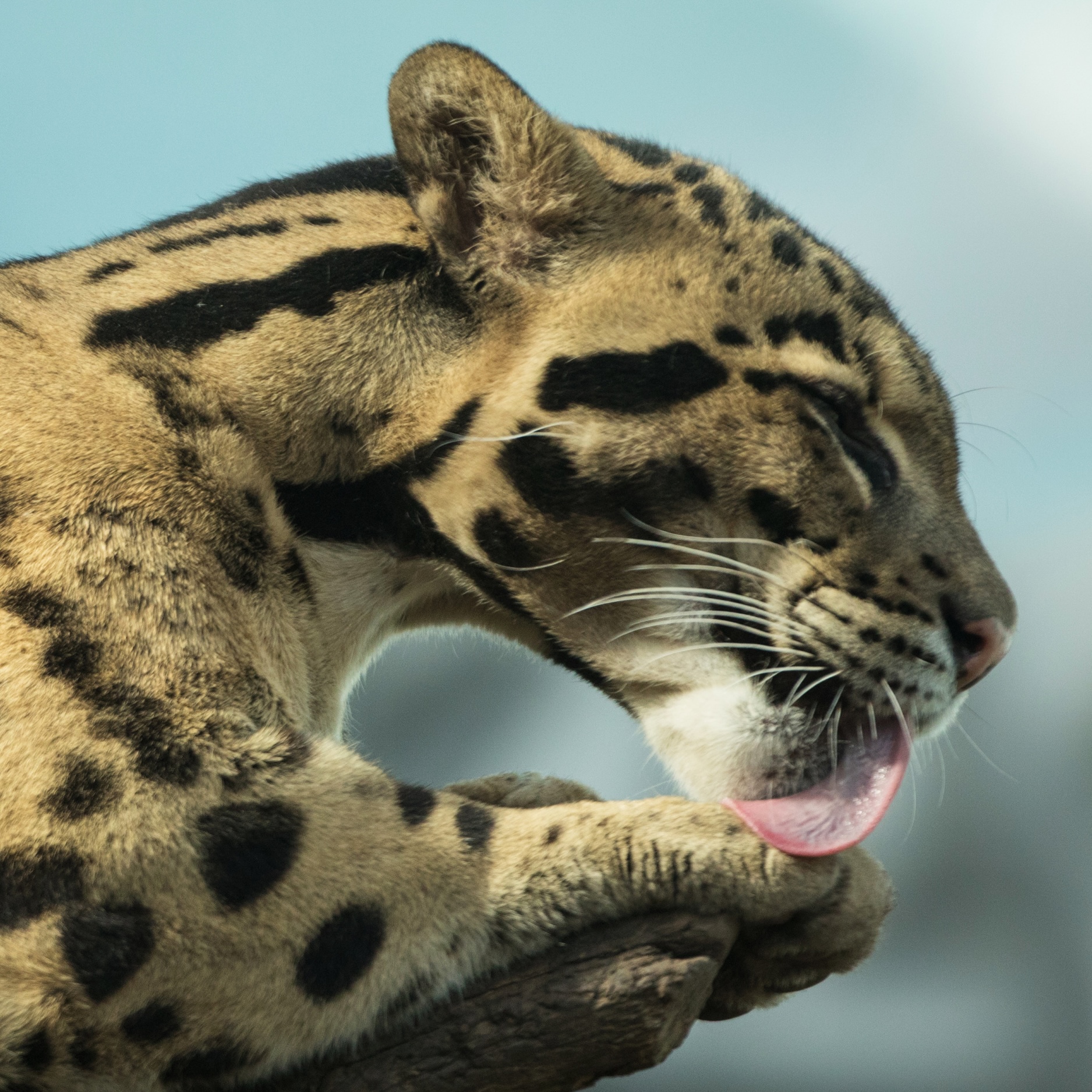 Clouded leopard (Neofelis nebulosa) in its natural
canopy habitat.
Clouded leopard (Neofelis nebulosa) in its natural
canopy habitat.
Meet the Clouded Leopard
The clouded leopard (Neofelis nebulosa) is a medium-sized wild cat native to the dense tropical and subtropical forests of Southeast Asia. Named for the large, cloud-shaped blotches on its coat, it is the smallest of the "big cats" and one of the most elusive. Adults weigh between 11 and 23 kg (25–50 lb) and measure roughly 70–105 cm in body length, with a tail nearly as long as their body.
Clouded leopards are exceptional climbers — their ankles rotate backward, allowing them to descend trees headfirst and even hang from branches by their hind feet. They have the longest canine teeth relative to skull size of any living cat, earning them comparisons to the saber-toothed cats of prehistory.
Habitat
Clouded leopards inhabit primary evergreen tropical rainforest, seasonally dry forest, and secondary logged forest from the Himalayan foothills to mainland Southeast Asia and Borneo. They prefer dense canopy cover at elevations up to 2,500 m, where the continuous tree-crown layer allows arboreal movement. Fragmentation — driven by logging, agriculture, and road building — isolates populations, reduces genetic diversity, and increases human-wildlife conflict.
Breeding & Reproduction
Clouded leopards reach sexual maturity at approximately two years, with a gestation period of 85–93 days. Litters typically contain 1–5 cubs, though 2–3 is most common. Cubs are born blind and helpless, weighing about 140–280 g, and open their eyes at roughly 10 days. They are weaned by five months and begin exploring independently by nine months.
Breeding in captivity presents significant challenges: males can be highly aggressive toward unfamiliar females, and pair compatibility must be carefully managed. The Species Survival Plan (SSP) has found that introducing pairs at a young age dramatically improves compatibility and reproductive success.
Predators & Prey
Prey
Clouded leopards are opportunistic carnivores. Their diet includes primates (macaques, gibbons, langurs), small deer (muntjac, mouse deer), wild boar, birds, porcupines, and squirrels. Their arboreal agility allows them to ambush prey in the canopy — an ecological niche few other predators fill.
Predators & Competitors
Adult clouded leopards have few natural predators, though tigers, leopards, and dholes may kill them in areas of overlap. Cubs are vulnerable to large raptors and pythons. Their primary threat, however, is anthropogenic: humans through poaching, habitat destruction, and the illegal wildlife trade.
Why Are Clouded Leopards Endangered?
The clouded leopard is classified as Vulnerable on the IUCN Red List, with populations declining across virtually all of their range. Four primary drivers push this species toward extinction:
Habitat Loss & Fragmentation
Southeast Asia has one of the highest deforestation rates globally. Between 2001 and 2019, the region lost over 61 million hectares of tree cover — largely to palm oil plantations, rubber farming, and logging. This shatters the continuous canopy that clouded leopards rely on for movement and hunting.
Poaching & Illegal Trade
Clouded leopard pelts, bones, and teeth are sold in illegal wildlife markets. Their parts are used in traditional medicine and as luxury decorative items. Snares set for other animals also incidentally kill or injure clouded leopards.
Human Encroachment
As human settlements expand into forested areas, clouded leopards are pushed into smaller, more isolated patches. They may prey on livestock, leading to retaliatory killings. Roads fragment habitat corridors and increase roadkill mortality.
Climate Change
Rising temperatures and shifting rainfall patterns alter forest composition and prey availability. Montane forests — critical refugia — may shrink as temperature zones shift upward, reducing habitat at exactly the elevations clouded leopards depend upon.
Geographic Range
The clouded leopard's range extends from the eastern Himalayas through mainland Southeast Asia to southern China. Historically, the species was found across a vast swathe of tropical and subtropical forest; today, populations are fragmented and confined to increasingly isolated forest blocks. The Sunda clouded leopard (Neofelis diardi), found on Borneo and Sumatra, was recognized as a separate species in 2006.
Goals & Objectives
The overarching goal of this recovery plan is to stabilize and ultimately grow the wild clouded leopard population to a minimum viable level of 15,000 individuals across connected habitat corridors within 25 years. This target demands coordinated action across governments, NGOs, local communities, and the global scientific community.
Protect Habitat
Secure and restore 50,000 km² of connected forest across the species' core range.
Eliminate Poaching
Reduce poaching-related mortality by 90% through enforcement and community engagement.
Sustain Genetic Diversity
Maintain a genetically viable captive population of 120+ breeding individuals across AZA-accredited facilities.
Engage Communities
Build local economies that benefit from leopard conservation, reducing human-wildlife conflict.
Advance Research
Deploy camera-trap networks and GPS collaring to map population dynamics and habitat use.
Solutions
Habitat Protection & Restoration
The single most impactful action is protecting existing primary forest. This involves strengthening protected-area legislation, funding ranger patrols, and expanding national parks in key clouded-leopard corridors such as the Tenasserim Hills (Thailand– Myanmar border) and the forests of northern Laos. Beyond protection, active reforestation — planting native dipterocarp and fig species — will rebuild canopy bridges between isolated fragments. Wildlife corridors at least 2 km wide should connect reserves, allowing gene flow and natural dispersal. Because clouded leopards are arboreal, these corridors must emphasize tall, continuous canopy rather than simple ground-level plantings.
Anti-Poaching & Law Enforcement
Effective anti-poaching requires a layered approach. Trained ranger units equipped with SMART (Spatial Monitoring and Reporting Tool) technology will patrol high-risk zones. Intelligence networks will target the criminal syndicates that drive the illegal wildlife trade. Community informant programs — offering financial incentives for information leading to arrests — will deter local poaching. Penalties for wildlife trafficking must be strengthened: international cooperation through CITES enforcement is essential to shut down cross-border trade.
Captive Breeding & Genetic Management
The Clouded Leopard SSP coordinates breeding across approximately 70 clouded leopards in North American zoos. Because male aggression is a serious barrier, the SSP now pairs animals before 12 months of age and houses pairs in large, enriched enclosures with climbing structures that mimic natural canopy. Artificial insemination and genome banking further safeguard genetic diversity. The long-term goal is to build a self-sustaining captive population that could support reintroduction into restored habitat — a process that demands rigorous behavioral conditioning, soft-release protocols, and post-release monitoring.
Accounting for Behavior & Ecology
Any recovery strategy must respect the biology of the species. Clouded leopards are solitary, nocturnal, and primarily arboreal — solutions that assume they will cross open ground (like ground-level wildlife crossings) are inadequate. Corridor design must include continuous canopy and minimize edge effects. Protected areas must be large enough to support viable home ranges (25–50 km² per individual). Breeding programs must pair animals young, provide vertical space, and minimize stress — loud visitors and concrete enclosures are counterproductive.
Economic Justification
The estimated cost of this recovery program over 25 years is approximately $260 million — a significant investment. However, the forests that clouded leopards inhabit provide ecosystem services worth tens of billions of dollars annually: carbon sequestration, watershed protection, flood prevention, and non-timber forest products. A landmark 2019 study in Nature valued Southeast Asian tropical forests at approximately $1,500 per hectare per year in ecosystem services. By protecting 50,000 km², this program would conserve roughly $7.5 billion in annual ecosystem value — returning over $28 for every $1 invested. Beyond economics, the ecotourism potential is substantial: community-based tourism programs in clouded leopard habitat in Borneo already generate significant local income.
Timeline
2027 – 2032
Foundation & Assessment
- Complete range-wide population survey using camera traps and eDNA sampling.
- Establish 10 new protected-area expansions totaling 8,000 km².
- Deploy SMART patrols across 15 priority landscapes.
- Begin captive-breeding expansion: increase SSP population to 100 individuals.
- Launch community livelihood programs in 50 buffer-zone villages.
2033 – 2040
Active Recovery
- Complete forest corridor plantings connecting 5 major reserves.
- Reduce snare density by 80% in target zones through patrol and removal.
- Initiate pilot reintroduction of captive-bred individuals into restored habitat.
- Establish transboundary conservation agreements (Thailand–Myanmar, Laos–Vietnam).
- Scale ecotourism programs to 100,000 visitors/year, generating $25M annually for communities.
2041 – 2051
Population Growth & Self-Sustaining Ecosystems
- Achieve target population of 15,000 wild individuals.
- Confirm genetic connectivity across all major habitat blocks via DNA analysis.
- Transition patrol funding to national government budgets for long-term sustainability.
- Publish 25-year findings and refine global felid conservation models.
- Petition IUCN for reclassification from Vulnerable to Near Threatened.
Funding & Resources
Recovery at this scale requires sustained, multi-source funding. The table below estimates costs over the full 25-year implementation period. Funding will be sourced from international conservation grants (GEF, CEPF), bilateral aid, carbon-credit programs, and private philanthropy.
| Resource | Description | Estimated Cost |
|---|---|---|
| Protected Areas | Land acquisition, legal designation, infrastructure for 10 new reserves. | $80 M |
| Ranger Programs | Salaries, equipment, SMART technology for 500+ rangers across 15 landscapes. | $55 M |
| Reforestation | Native-species plantings, wildlife corridor construction, nurseries. | $40 M |
| Captive Breeding | SSP expansion, enclosure construction, veterinary care, genome banking. | $30 M |
| Research & Monitoring | Camera traps, GPS collars, eDNA kits, satellite imagery, data platforms. | $25 M |
| Community Programs | Livelihood training, ecotourism development, human-wildlife conflict mitigation. | $20 M |
| Policy & Enforcement | Legal reform advocacy, CITES enforcement, cross-border cooperation. | $10 M |
| Total Estimated Investment | $260 M | |
Measuring Success
Success must be measured not by effort alone but by measurable ecological outcomes. The following metrics will be assessed on a rolling basis and reported annually to all stakeholders.
Camera-Trap Surveys
Standardized camera-trap grids across all 15 priority landscapes will estimate population density, occupancy rates, and individual identification via coat-pattern recognition.
Every 2 years
Genetic Monitoring
Non-invasive genetic sampling (fecal DNA, hair snares) will track effective population size, inbreeding coefficients, and gene flow between fragments.
Every 3 years
Habitat Monitoring
Annual satellite imagery analysis will quantify forest cover, canopy height, and corridor connectivity using Global Forest Watch and LiDAR data.
Annually
Anti-Poaching Metrics
Track patrol effort (km patrolled), snares removed, arrests made, and prosecution rates. Compare poaching incident trends year-over-year.
Quarterly
Captive Population Health
Monitor SSP studbook metrics: births, deaths, genetic diversity index, pair compatibility scores, and cub survival rates.
Annually
Community Impact
Survey household income changes, attitudes toward wildlife, and ecotourism revenue in buffer-zone communities to ensure local buy-in.
Every 2 years
Sources Cited
- Grassman, L., Lynam, A., Mohamad, S., et al. (2017). Neofelis nebulosa. The IUCN Red List of Threatened Species. iucnredlist.org
- World Wildlife Fund. "Clouded Leopard." worldwildlife.org
- Smithsonian's National Zoo & Conservation Biology Institute. "Clouded Leopard." nationalzoo.si.edu
- National Geographic. "Clouded Leopard." nationalgeographic.com
- Panthera. "Clouded Leopard." panthera.org
- Animal Diversity Web (University of Michigan). "Neofelis nebulosa." animaldiversity.org
- Global Forest Watch. "Forest Monitoring Designed for Action." globalforestwatch.org
- Costanza, R., et al. (2014). "Changes in the global value of ecosystem services." Global Environmental Change, 26, 152-158.